Priorities....priorities

I'm not a very good conservation starter but I know bringing up abortion is definitely not a good way to break the ice. This is one subject I tend to stay away from as people can be extremely volatile in discussing and expressing their opinions regarding it. However, a recent article in the Texas Monthly, brings up a very important issue regarding this topic and the efforts to curb the procedures. 

The main symbol of abortion in Texas is Planned Parenthood, a non-profit organization that provides reproductive health as well as maternal health services in the U.S. and internationally. Planned Parenthood has been the target of elected officials and opposition groups in the past, and is back in the spotlight after a controversial edited video was released by an opposition group shows Deborah Nucatola, the senior director of medical services at Planned Parenthood, discussing the selling of tissues from aborted fetuses back in July. 

More recently, Texas Health and Human Services Commission inspector general Stuart W. Bowen Jr.  announced his department is seeking to remove PP from Texas’s Medicaid program. Medicaid, a social health care program for families and individuals with low income and limited resources, is also at the heart of this issue since it's a Federally funded program--however, the State decides how to distribute the funds which, according to Federal mandates allow any willing and competent provider to be eligible. 

It's quite absurd at the speed and the amount of attention the State of Texas to gives to this. While Austin floods again, Hidden Pines smolders and Texas Education ranks 39th nationwide, somehow this is a priority for our local government. Priorities....priorities. Somehow to subpoena (allegations of Medicaid fraud) Planned Parenthood to disclose the medical records and information of it's patient and another to disclose the names, salaries, home addresses, and home phone numbers for all Planned Parenthood employees to the State is a priority.

Yes...I get that fraudulent activity is a important issue to address but it's fairly obvious that it's not why the State has put on so much pressure on the facility. If the State has strong evidence against PP, then why does it need so much information from the facility in the first place. Seems like their hoping that if they throw enough mud that some of it will stick. Whatever happened to innocent before proven guilty?

Texas has also flirted with the idea of arbitrarily removing PP from Medicaid back in 2010. A report from Texas Health and Human Services Commission and the Texas Department of Insurance shows some of the devastating effects it would have.

The fact that the State would even consider weighing these outcomes because of it's stance against PP is appalling. It's time that the State start focusing on more of it's time, energy and effort on more pressing issues such as fracking, education and emergency preparedness.

Money doesn't equal security

Money doesn't equal security
Erica Grieder recently shared a blog post, The Cost of Border Security, on Texas Monthly's blog section, Burka Blog, that explores the cost of a border security in Texas, the rationale behind it and whether it is worth it or not. Ms. Grieder, a senior editor at Texas Monthly and former correspondent for The Economist, first contends the logic behind spending $800 million on border security when a recent polling of Texans finds that only a very small minority of them believe the expenditure will be "highly effective". She then points out how many Democratic legislators don't even know how the State plans to spend the money. I found her use of simple logic to question the massive expenditure quite effective and reasonable. Her audience, Texas citizens, should able to easily digest and contemplate her arguments.

There really isn't much else to dissect. If people in our own State House can't layout how a massive expenditure is being utilized and the majority of Texans don't feel confident that it will succeed, why should we go forward with it? She then asserts that some of the other methods, that proponents for the expenditure support, for illegals to gain citizenship actually help incentivize illegal immigration. She easily exposes the contradictory attitude of the proponents and leaves little doubt that this massive expenditure should be reviewed. I don't believe this is a problem we can solve by just throwing money at it. This is also a international border, as she mentions, whose responsibility ultimately falls on the Federal Government.

The number is off a by a few hundred million but the point remains.

Complexity on top of complexity

Complexity on top of complexity
A recent column piece from former U.S. Representative Pete Gallego, who served in the U.S. House from 2013-2015 and prior, the Texas House for over 20 years, reviews the confusing nature of Texas Voter ID laws and the implications that follows. In his Texas Tribune article, he cities a recent study by Rice University that details the impact of voter confusion and voter turn out.

Just to refresh what the Texas Voter ID law is, as quoted from the the study,
 "In 2011, the Texas Legislature passed Senate Bill 14 (SB 14) that created a new requirement for voters to show photo identification when voting in person." 
 After some back and forth between all three levels of the Courts, the photo ID law went into force on November 2014. Mr. Gallego mentions

 "The study focused on my 2014 campaign in the 23rd Congressional District. I lost that race by about 2,400 votes. But according to the researchers, the results likely would have been different if the voter ID law hadn't been in effect, or if voters had been provided more information about the law."

While the 2014 election is over, Mr. Gallego does bring a very important point I concur with. Registering to vote in Texas is confusing enough but why add more complexity to something already contorted? We are in the year 2015 and we have amazing technologies that can do extremely complicated operations with ease yet people in Texas still have to physically print out the forms, fill them out and mail them and wait for their forms to get processed and hope they don't get lost in the mail. This takes time-a luxury most hard working people don't have.


Even if some people do get to finally vote, they might not even understand what they voted for.


But heaven forbid one moves into a different county, you have to register again and lets hope your ID isn't expired, is in good shape and you haven't lost too much weight! You might have to get a new or renew your ID if that's the case, I hope you have a bit of spare change because that isn't free.


Mr. Gallego understands this very well and gives possible solutions in alleviating the confusing process however, even before we begin down that road, I believe we should look back and fix the starting line so that there are less stragglers from the start and create a voter registration system that doesn't seek to subtlety disenfranchise a demographic of voters through the use of confusing and restrictive laws. There is a reason Texas has some of the lowest turn outs in election and that's because people don't even understand how to or have the means to get started.


While yes, there is a legitimate concern regarding voter fraud, voter fraud is minuscule as the Washington-Post reports 31 credible incidents of voter fraud out of a billion cast. Clearly voter fraud isn't the genuine reason behind the push for these laws. Who knows what other requirements they'll have next.


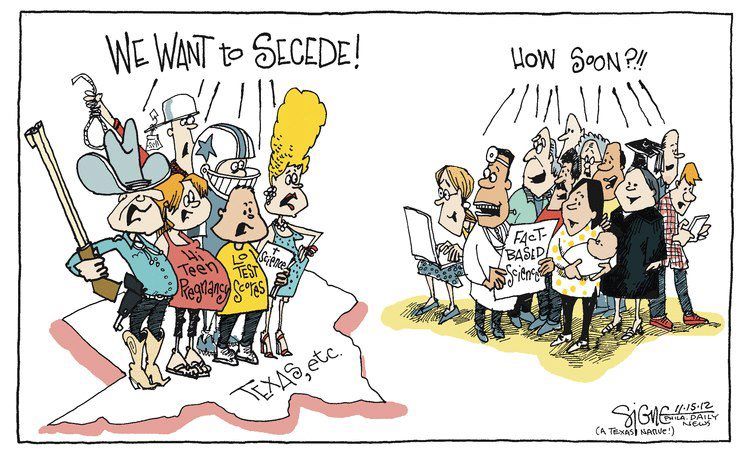
Texas secession, more than a dream...

Texas secession, more than a dream...
On September 17, 2015, KXAN, an Austin news station, reported that an effort to have Texas secession on the GOP Primary ballot in March 2016 is being made. KXAN’s article, Petition started to get Texas to secede, explains that an organization calling itself, The Texas Nationalist Movement, has collected over 1,000 signatures throughout the State with a goal of collecting 75,000 signatures in the next 75 days. A visit to their site shows that a serious effort is being applied in attempting to collect signatures with events taking place in Ft. Worth, Tyler, Corpus Christi and other various cities throughout the Lone Star state.

Supporters of The Texas Nationalist Movement gather at the front of the Texas Capitol in Austin, Texas.
This article is important because it highlights the mentality of how many Texans view themselves in regard to the entire country and reinforces the notion that Texas can secede from the United States, which it cannot. A volunteer within the movement, Warren Peck, states “Texans are special. Texans are Texans first before we are anything else”, demonstrates this notion as discussed in class. But aside from re-affirming that many Texans still romanticize seeing Texas become an independent nation again, it can be derived from the article that many people are not happy with our national government and believe our local government can do a better job. Whether this movement gains traction or fizzles out into another dream is yet to be seen.

Others may greet a Texas secession with the same enthusiasm but for different reasons.

Please note that the author of this blog does not support or condemn any Texas secession. But if you wish to sign the petition, you can do so here and if you would like to contribute, the Texas Nationalist Movement is accepting volunteers which requests can be submitted at this link.